

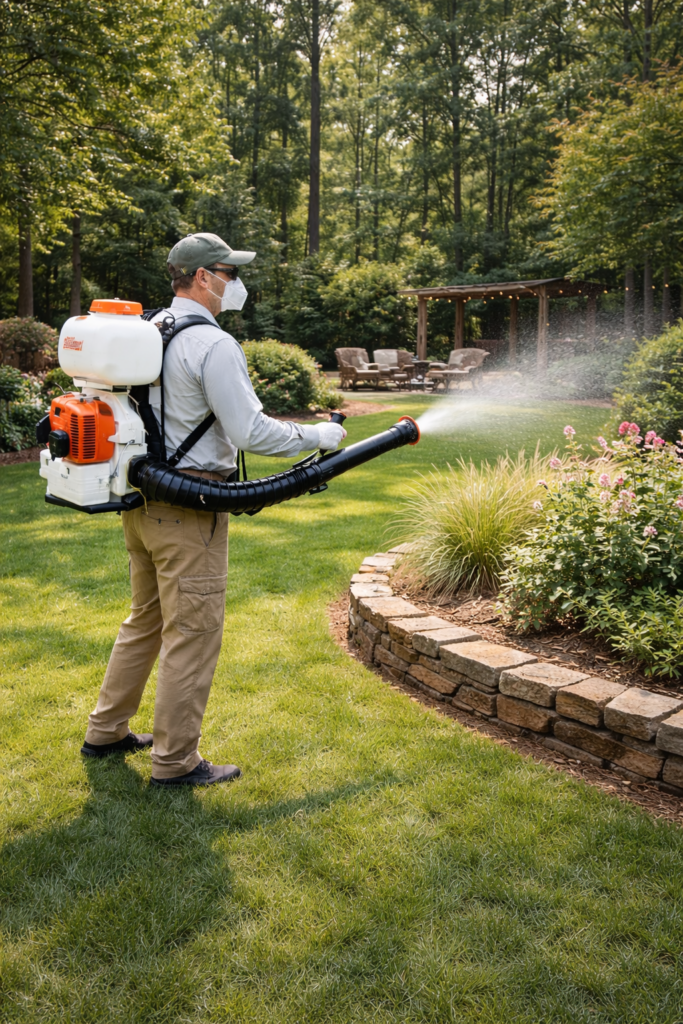
Mosquito Control Service in Franklinton, NC
In Franklinton, mosquito season starts earlier and runs later than most people expect. The mature tree canopy that shades many of the older neighborhoods creates cool, moist understory conditions that extend mosquito activity well into October. Add the clay soil that holds surface water for days after a rain, the proximity to natural areas and woodland edges on the outskirts of town, and the older drainage infrastructure in established parts of Franklinton — and you have the conditions for persistent, heavy mosquito pressure from April through fall.
Distinct Lawns is based in Franklinton. We treat residential properties throughout Franklin County, and we’re familiar with which neighborhoods and lot types generate the most mosquito pressure. Our barrier spray program is designed to give you your yard back — so outdoor evenings, backyard cookouts, and kids playing outside after dinner are actually comfortable again.
What Creates Mosquito Pressure in Franklinton
Mosquitoes need three things: standing water to breed, sheltered vegetation to rest in during the day, and warm temperatures to accelerate breeding cycles. Franklinton has all three in abundance.
Heavy clay soil and standing water
Franklin County clay doesn’t drain. After a significant rain, water sits on the surface in low spots, puddles near downspouts, and in the shade of mature trees for 24–48 hours or more. A mosquito can complete its entire breeding cycle — from egg to adult — in 7 to 10 days in warm, shallow standing water. You don’t need a pond. A shallow depression in the yard, a low spot near the foundation, or a poorly draining section of lawn is enough to sustain a local mosquito population through the entire summer.
Mature tree canopy and ground cover
Franklinton’s older neighborhoods have canopy that most newer suburbs don’t. The shade those trees create keeps the ground cooler and moister — which extends the surface water window after rain and provides ideal daytime resting habitat for adult mosquitoes. Dense ground cover under trees (pachysandra, ivy, liriope) amplifies this effect: it traps moisture and provides shelter that adult mosquitoes actively seek out.
Woodland and natural area edges
Many Franklinton properties back up to wooded areas, creek drainages, or open land. These natural edges are permanent mosquito breeding and resting habitat that you can’t eliminate — but you can create a barrier between them and the areas where you spend time.
How Our Barrier Spray Treatment Works
Adult mosquitoes spend the vast majority of their time resting in shaded vegetation — not flying. They emerge at dawn and dusk to feed, then return to sheltered spots in your shrubs, ground cover, and perimeter plantings for most of the day. Our barrier spray targets those resting sites directly.
We treat the vegetation on your property with a residual product that remains active for 21 days after application. When mosquitoes contact treated plant surfaces, they’re eliminated. The product breaks down in sunlight over those 21 days, which is why treatments are scheduled on a 21-day cycle through the season.
Where we treat:
- Ornamental shrubs and foundation plantings around the home
- Ground cover areas — ivy, pachysandra, liriope, and similar plants where mosquitoes rest in high numbers
- Wooded edges and natural areas at your property line
- Shaded areas under decks, porches, and overhangs
- Tall grass and perimeter vegetation along fences and property edges
We work around vegetable gardens, active pollinator plantings, and flowering beds. We don’t spray open flowers or areas where bees are actively foraging.
Product Safety for Families and Pets
We offer both conventional and organic treatment options.
Standard treatment uses a synthetic pyrethroid — widely used in professional mosquito programs, effective at the concentrations we apply, and approved for residential use. It breaks down in sunlight within 21 days. The primary safety precaution: keep people and pets away from treated areas for 30–60 minutes after application until the product has fully dried.
Organic treatment uses plant-based essential oil formulations — primarily clove oil, peppermint oil, and rosemary oil — that are effective against mosquitoes and break down quickly in the environment. The organic option typically provides 14–18 days of protection rather than 21, so treatment intervals may be slightly shorter. It’s appropriate for households with very young children, pets with chemical sensitivities, or homeowners who prefer to avoid synthetic products.
We’ll discuss which option makes sense for your situation during the estimate. There’s no right or wrong answer — both work, and both are safe when applied as directed.
Seasonal Coverage for Franklin County
Mosquito season in Franklinton typically runs from late April through early October. Our standard program covers this window with treatments every 21 days:
- April: First application as temperatures stabilize above 60°F and mosquitoes become active
- May–September: Peak season treatments every 21 days — this is when pressure is highest and consistent coverage matters most
- October: Final application as temperatures drop and activity begins winding down
We also schedule individual event treatments for one-time occasions — outdoor parties, family gatherings, graduation celebrations — where you need reliable protection for a specific date rather than ongoing coverage.
Bundling Mosquito Control With Lawn Care
Many Franklinton homeowners bundle our mosquito control program with fertilization and weed control. The combination makes practical sense: a healthy, dense lawn with managed vegetation has fewer natural mosquito resting sites than a patchy or overgrown one. Trimmed ground cover, reduced thatch, and better turf density all reduce the amount of habitat available for mosquitoes to shelter in.
A full-service relationship also means we know your property — the areas that drain poorly after rain, the spots with dense ground cover that hold moisture, the sections of perimeter vegetation that need more attention. That knowledge improves the mosquito treatment the same way it improves the lawn program.
We also offer sod installation in Franklinton for homeowners dealing with large bare or weed-dominated areas that are better rebuilt than treated.
Frequently Asked Questions
Do you serve areas outside Franklinton town limits?
Yes. We serve unincorporated Franklin County, Youngsville, Creedmoor, Wake Forest, and surrounding areas. If you’re unsure whether we cover your address, call or text us.
My yard backs up to woods. Can you do anything about the mosquitoes coming from there?
Yes — this is actually the most common situation in Franklinton. You can’t treat the woods, but you can create an effective barrier between the woods and your living space by treating the perimeter vegetation on your property. Mosquitoes that cross your property line need somewhere to rest before they’re close enough to bother you. Treating that vegetation intercepts them before they reach your porch or patio.
How long does each treatment take?
Most residential properties take 15–30 minutes. We’ll be in and out quickly, and you don’t need to be home.
What if I still see mosquitoes shortly after a treatment?
Some adult mosquitoes move into treated areas from surrounding properties between visits. If mosquito pressure seems higher than expected within a treatment cycle, call us — we’ll assess whether a supplemental treatment is warranted. Our goal is for you to be able to use your outdoor space comfortably, not just to complete a scheduled visit.
Request Your Free Estimate
We’ll evaluate your property, assess the areas with the highest mosquito pressure, and give you straightforward pricing with no surprises. No contracts required.
📞 Call or text: (919) 328-3973
🌐 distinctlawns.com
Serving Franklinton, Youngsville, Creedmoor, Wake Forest, and surrounding Franklin County.